Welcome to the Chaco Digital Initiative!  CDI is a collaborative effort
to create a digital archive that will integrate much of the widely dispersed archaeological data collected from Chaco Canyon in the late 1890s and the first half of the 20th century.


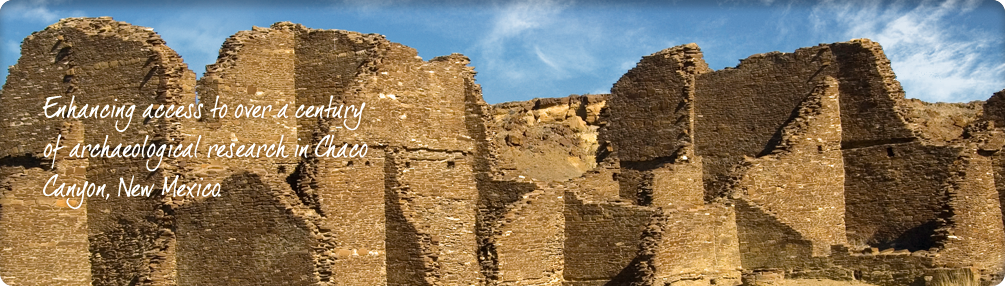
Today the ruins of the Chaco Culture National Historical Park hold great meaning to many Native American Nations of the Southwest as sites of ancestral importance.  Though it has long been recognized as a sacred place by indigenous peoples, its magnificence was later discovered by Anglo explorers.  Having stood the test of time, the ruins of Chaco Canyon entered the broader public consciousness in the late nineteenth century as a vivid symbol of the cultural resources of the United States.

Since the founding of the Chaco Canyon National Monument in 1907, Chaco has been at the forefront of the historic preservation movement. Due to the early research efforts of Richard Wetherill, George Pepper, and Edgar Hewett, the monument was created in conjunction with the Federal Antiquities Act of 1906 (the first piece of legislation designed to protect cultural resources). In 1987, Chaco Canyon was designated a UNESCO World Heritage Site signaling its importance as a valued part of international cultural patrimony. Today, Chaco era ruins continue to be a focus of preservation efforts both domestically and abroad.      

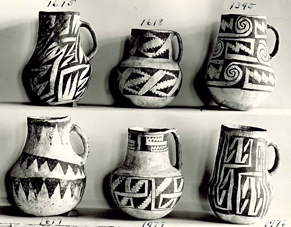
Early excavations of the 1890s and 1920s in Chaco Canyon centered on discovering the genesis and evolution of the prehistoric “Anasazi” inhabitants.  These early research efforts, conducted by the American Museum of Natural History, the National Geographic Society, and the Smithsonian placed Chaco at the center of the evolving discipline of archaeological science.  Today, the Chacoan Phenomenon (Irwin-Williams 1978) continues to be a touchstone in debates about prehistoric culture change within the discipline of archaeology.  (See the following website for a summary of recent issues.)

Through generous funding from the Andrew Mellon Foundation, the mission of the Chaco Digital Initiative is to ensure that the early archaeological research records are preserved for and accessible to future generations.  Currently these materials are scattered around the country at various repository institutions, making it difficult to answer some fundamental research questions.  Our goal is to make the research and human history of this national treasure available through a comprehensive digital research archive that will allow people to search information such as field notes, images, maps, and tree ring dates by user specified criteria.  Users will also be able to browse data through a graphical interface.  When completed in 2009, we hope that the Chaco Digital Initiative will continue to place Chaco Canyon at the forefront of preservation efforts in the United States and abroad and serve as a model for the role of new technologies in archaeological scholarship.

PHASE 1 of CDI is currently available. PHASE 2, when completed in 2009, will allow researchers to more effectively and efficiently address the many unresolved issues regarding culture change in the canyon and the surrounding region.  Though the project is ongoing, we will continue to make information available to the broader community as quickly as possible.  Please check back as we are frequently adding information.  If you would like to join our email list for periodic updates please contact us with the word “subscribe” in the subject field at chaco@virginia.edu.